Archive
The iWatch – is this the next disruptive innovation from Apple?
Apple has developed a reputation for creating new markets that didn’t exist previously. The iPod was not the first mp3 player but it created a mass market. The iPhone launched the SmartPhone era – showing BlackBerry the potential of an Internet enabled phone, in a way that has almost killed BlackBerry’s manufacturer, RIM. The iPad was the next innovation – but since then nothing at all except rumours. The rumours include an Apple TV that would shake up the television industry, and an Apple watch – the iWatch. The AppleTV was said to be the next big innovation – and was briefly mentioned in Steve Job’s biography, where apparently Apple had something that would really shake up the TV industry. Nevertheless, the rumours relating to this have died down – and the iWatch is the latest rumour target.

One idea on the iWatch
My first thoughts on seeing images of the rumoured iWatch were why?
Why would anybody want something like this on their wrist when there were so many beautiful products from Citizen, Seiko, and higher-upmarket, Rolex & Patek Phillipe, among many others. It didn’t even have the look of the Swatch watch.
I also couldn’t see it as a replacement for a SmartPhone – as it’s too small to do all the current functions expected of phones that seem to be getting bigger, not smaller. So I personally dismissed the iWatch as just rumour, or a sign that Apple had lost its mojo, if it turned out to be true.
Nevertheless, the rumours have become pervasive – and so I’m sure that they are either a smokescreen or reflect something real.
I started to think about it. The watch market can be divided up into a number of sectors. One sector views watches as a form of jewellery – and this is the market Rolex, Patek Phillipe follow. To an extent it is also the market that Citizen and Seiko chase too – although their watches also emphasise functionality, with the Seiko Solar and the Citizen Ecodrive watches that don’t need batteries or winding. Further downmarket, Swatch tries to be a fashion item. However all have a basic raison d’être – to tell the time. I couldn’t see an Apple watch easily replacing the jewellery element (or at least not initially). I doubt it will be a solar product – and so (again initially) it won’t replace Seiko or Citizen. It could compete with Swatch, but from previous Apple history would be much more expensive and so bring little to the pie.
The next question is who wears watches today – and that gave the clue to why I think the iWatch is real. Most watch-wearers are Generation X or older. Millennials / Digital Natives don’t wear watches. They use their SmartPhones to tell the time. That’s the clue – and the target. A SmartWatch – especially if it could interact with existing devices – makes a lot of sense, as it could provide a more compact device to supplement their iPhone, iPod and iPad or even replace them for around the house, workplace or college dorm. I think that contrarians that say such a device won’t work are falling for the mistake I think I made, by not thinking about how people tell the time today. The potential problems revolve around the other expected features. Will it also be a phone? A music player? A portable sat-nav device? How would these work ergonomically?
Assuming that the iWatch is real and not a smokescreen for something else, the argument that it won’t be attractive fails when you see some of the suggested design concepts. Some are very attractive and wearable as both a fashion item and even as jewellery. The potential objections to functionality are also less if the iWatch were to interact with other devices. The problem here is that there may be an expectation that the interaction is with another Apple device – which would mean that the iWatch would not be a stand-alone product. This limits its potential considerably. What about linking to Android phones – that have overtaken the iPhone in overall market share – or a Windows computer? If this were to be allowed then I think the iWatch would be another Apple success story.
If this is the case, then it does something else. The onset of quartz watches in the 1980s was highly disruptive to the Swiss watch industry. Initially the Swiss industry dismissed such timepieces as cheap and nasty, but in classical disruptive innovation style, they soon overtook mechanical watches to become the dominant format. The rise of quartz watches caused serious damage to Switzerland’s watch industry – until it recognised the threat, and created products such as the Swatch. An Apple iWatch that succeeds promises to be equally disruptive – and overtime, most of us may end up wearing such products.
Microsoft’s Surface and Disruptive Innovation!
There is an old video with Bill Gates talking about Microsoft and Windows version 3, looking at multimedia, pen computing and an early tablet computer. Circa 1991! The technology shown in the video was forward thinking. Today we take it for granted. This was a time pre-web when only businesses had computers. Few people had computers at home and few knew about email or the Internet.
The idea of tablet computers is not new. Both Microsoft and Apple had looked at the idea years ago, but at the time the technology was not sufficiently fast, sophisticated or useful enough to grasp the majority of consumers’ interests. Techies loved such devices. (At about this time, ago, I had a boss who had a Psion Organiser. He loved it. Everybody else wondered what he saw in it).
That’s the issue with disruptive innovations. It’s not just the disruption that counts. It’s the timing. The Microsoft tablet was like the Psion organiser, and even the more tablet like Apple Newton device.
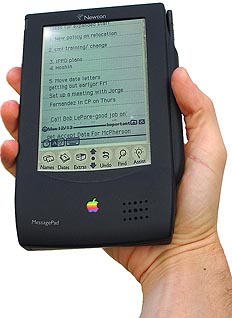
The idea was a great idea but the timing was too early, and the product was not able to capture the consumer mind.
It’s not the first company that comes out with a disruptive innovation. It’s the first company that captures the consumer’s share of mind – their imagination.
As another technological example, the Apple iPod was not the first mp3 player. There were a few before (e.g. the MDiamond Rio and the MPMan player) – but they didn’t have the panache of the iPod – and so were quickly overtaken when the iPod entered the scene.
At the same time, entering too late – or basing your product on competitors is also not the way – as Microsoft’s Zune product showed.
The jury is still out on Microsoft’s iPad type product – the Surface. This, at least, is not a copy but something different. To a large degree, it’s fate will depend on Windows 8 (RT). I think the Surface has a place – and I can see it destroying the netbook and low-value laptop market, and so it will be disruptive. I don’t believe that it will damage the iPad or most Android tablets (and also not the Kindle type e-book reader). People buy these for the apps – and there are too few Windows based apps. I don’t see this changing with Windows 8 either. (Why should an apps developer spend time and money building a Windows based app when the vast majority of tablet computers & smart phones are Android or Apple iOS?)
So who will buy the Surface. Techies – obviously! However businesses that currently equip sales people with netbooks or low-price laptops will also go for it as it is lighter, cheaper and trendier while offering the same or greater utility than the netbooks and laptops they had previously bought.
Of course time will tell. That’s what makes something truely disruptive – it’s often only after the new technology has taken over that you can say “but it’s obvious that it would succeed“. If this wasn’t the case – we’d all be flying across the Atlantic on another seemingly disruptive technology that failed to spread even though it provided utility, speed and worked. The supersonic Concorde aircraft never really took off, even though British Airways claimed it was profitable. Only British Airways and Air France flew Concordes. No other airline purchased the aircraft and the Concorde crash in Paris in 2000 effectively sealed its fate.

Go to AWARE's web-site



 Competitive Intelligence News
- ChatGPT for Information Retrieval and Competitive Intelligence - Packt
- Data for growth - Part 4: CRM data enrichment: Sales and marketing intelligence with AI - Moody's
- Lifesight Launches Mia Marketing Intelligence Agent - Let's Data Science
- First Look Games launches FLG Analytics marketing intelligence platform for iGaming studios - igamingbusiness.com
- Five Findings About Today’s Market And Competitive Intelligence Programs - Forrester
- 'Faster, Sharper, More Connected': TEAM LEWIS Launches AI 'SideKick' For Marketing Intelligence - bandt.com.au
- First Look Games Launches FLG Analytics, the iGaming Marketing Intelligence Platform for Studios - European Gaming Industry News
- My ‘detective’ job as a competitive-intelligence consultant for pharma - Nature
- Market Logic Software Included in Latest Market and Competitive Intelligence Platforms Landscape Report - Newswire.com
- Lifesight Launches “Mia,” an Agentic AI Marketing Intelligence Agent - Yahoo Finance

 Find It Out - Research Secrets and More