Archive
Forte 1 – truth or lie? A brief competitive intelligence case study.
I received a phone call today from a charming lady who claimed to work for a company called Forte 1. I knew nothing about her company which seemed to want me to switch my business telephone line, and also said that they offered computers at great prices, and more.

Our goal is to build long-term partnerships with our customers and maximise the potential of our traditional business, through a combination of enhanced quality of service and creativity. |
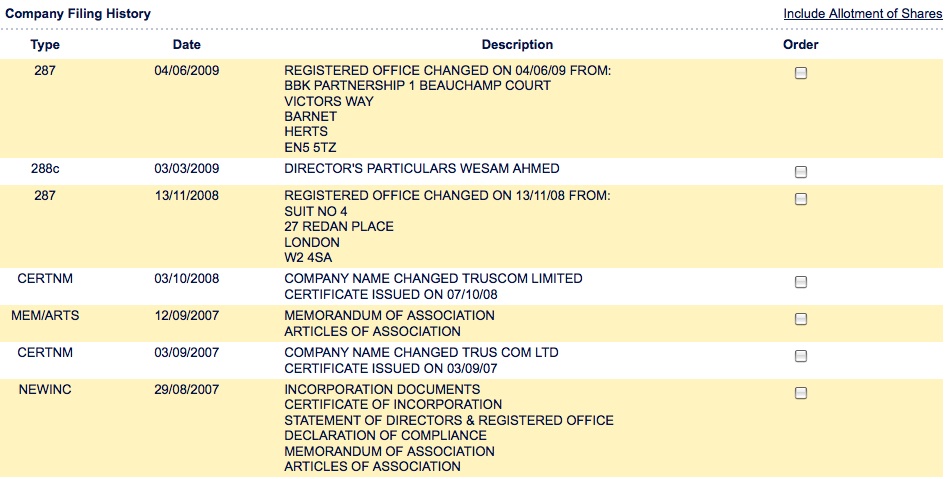 In fact, there appear to be several changes to the record since this company was founded – in August 2007. It first appeared as Trus Com Ltd, then changed to Truscom Ltd before metamorphosing into Forte1 Ltd in October 2008. The company has also changed address twice – from a W2 4SA address in London to an address in Barnet on the outskirts of London.
There are 5 domains hosted on this IP address.
Here are a few of them:
Emotional responses
I’ve not posted anything for months – not because I’ve not had things to post, but because of work pressures, and perhaps also not having anything I thought worth posting.
That’s not to say that things haven’t happened – but others will have posted on the London Online conference, the SCIP annual and European conferences in San Diego and Bad Nauheim, Germany, and the AIIP annual conference in Pittsburgh. I attended all – and each was worthwhile in its own way. (My favorite was AIIP – but then this is such a great organisation anyway!).
In the last few months I’ve also been to China where I led a workshop on CI, and on a personal level, celebrated my oldest nephew’s wedding in Jerusalem and saw the loss of my father a month later.
So what has prompted this post?
Well I try and link ideas to marketing and competitive intelligence. Those who know me will know that one of the areas I specialise in is competitive intelligence analysis and game theory. My talk at SCIP Europe (and also at the SCIP 2007 conference) was on Game Theory.
One of the areas I emphasise is that when looking at a competitor you should try and look at things from their perspective. Just because something looks stupid or illogical to you doesn’t neccssarily mean that it is stupid and illogical. It could also be that the competitor is viewing something from a different angle to you – and that if you switched viewpoints it would make perfect sense. Developing an ability to switch perspectives could save you $, £, €, or ¥ as it should lead to greater anticipation of how competitors are likely to respond and thus better and more effective strategies. The assumption is that competitors behave logically, and choose strategies based on the information and knowledge they currently have.
There is, however, an exception to this. Sometimes a competitor can be blinded by hatred, greed, fear, or another strong emotion. In such cases their decisions are likely to be stupid and illogical as they can’t see reality and instead, they base what they do on their emotionally biased view of the world.
As a result, when looking at a competitor it is also important to look for any emotional aspect in their decision making. Is this leading to how they behave or react? If it is, then you can use it against them to win out. Of course the same applies to you – and it’s important that you make decisions that are not based on emotional reasons. Decisions need to be made based on facts, evidence and logic – anything else will lead to vulnerabilities that can be attacked by a competitor.
There are many examples of companies that have made poor decisions based on emotion: a classic is the failure of the 2000 Time Warner – AOL merger, which was partly driven by Time Warner management’s fear of being left behind in a digital world. In fact many mergers fail as they are not really motivated by logic but more by fear of being left behind or greed – seeing acquisition as the best way to grow.
So when looking at a competitor, you need to
- assume that they are behaving logically – try to see things from their perspective
- consider that they may be acting emotionally, and not basing decisions on fact and logic.
Which of these two applies will depend on the pattern of decision making, the decisions made, and the competitor’s management. Part of the job of the CI analyst is to step back from their own emotional perspectives and, dispassionately, look at the competitor and decide what has led to their decisions and strategies: logic or emotion.
I still haven’t answered what prompted these thoughts.
Generally I try to understand the opinions and views of people with whom I disagree – and accept that often there is a valid rationale to these views. I fervently disagree with Islamic terrorist groups, and I totally support Israel. At the same time, I understand the view of the Palestinians and believe that they have a case. I understand the Islamic religious view of Hamas that Israel is occupied Islamic land and that only Islamic rule is valid. I don’t personally agree with this – but I accept that from some Islamic perspectives (not all) this is logical as it follows some Koranic precepts. So I’m applying my rule above of trying to understand the other side, and looking at things from their perspective.
I can even apply this (with difficulty) to some terrorist actions in Europe and the USA. The attacks on 911 were reprehensible, evil and criminal. However using the above principles I can understand these actions – as they fall into a logical pattern.
- Western Values represent an attack on Islamic values.
- Western Values are winning out – even in Islamic society.
- For Islamic values to triumph, Western values must be destroyed, so that the world realises that it’s only true Islamic values that will lead to human peace and happiness.
- What the West calls terrorism is actually a misnomer – and is, in fact, an attempt by true Muslim believers to alert their own governments to how they’ve been led astray, while at the same time to destroy the forces that are doing this – leading to a growth in Islamic values and beliefs.
What I fail to understand however, is how a follower of any religion can take advantage of people with mental problems and use them for terrorist activity. One of the basic principles behind all religions: Christian, Jewish, Islamic, Hindu, Sikh, Buddhist… is the protection of less-well-off and weaker members of society. They teach that it is a major sin to take advantage of such people.
The recent bomb attempt in Exeter, England, when an Islamic convert who was reportedly mentally ill, with low IQ and suffering from Aspergers, was so radicalised that he was preparing bombs to use to maim and kill people, suggests that the people behind him were not acting under any religious framework at all – but were driven by emotions only: hatred and fear. Worse, they bring shame on true Islamic believers, and through their actions will lead even more people to see Islam as an evil creed that only destroys and has no respect for the poor, sick and down-trodden. This is false! So called “Imams” who believe that they can recruit victims like poor Nicky Reilly have desecrated Islam and the teachings in the Koran and Hadith, and should be denounced by all true Muslims as false.
Communication
- planning & direction i.e. the boss – also known as the end-user 🙂 tells you what is needed and you or they work out how to get it;
- collection – you follow your plan;
- processing & analysis – you integrate the gathered information with other information to convert the information into something usable i.e. intelligence;
- dissemination – you pass back the intelligence to the end-user and hope that they act on it.
- the model lacks feedback steps;
- it doesn’t integrate with other business processes adequately, such as the strategic/business planning cycles;
- it doesn’t allow for serendipitous intelligence gathering crucial for effective early warning systems.
My focus in this item however is the use of the word dissemination. The Encarta® World English Dictionary defines disseminate as “to distribute or spread something, especially information…“. Most other dictionaries give similar definitions. The problem with this word is that it implies that information flows one way – from the collector to the end-user. There is no mention of information – feedback – flowing the other way or laterally throughout the organisation. Effective competitive intelligence needs an information sharing culture where information flows between those who have the intelligence and those who need it – each informing the other. The English word to describe this process is not dissemination, but communication.
The Encarta dictionary has a number of definitions for communication and the verb communicate. Communication is defined as “the exchange of information between individuals, for example, by means of speaking, writing, or using a common system of signs or behavior” while the second definition for communicate is “to transmit or reveal a feeling or thought by speech, writing, or gesture so that it is clearly understood“.
Isn’t this what we aim to do in competitive intelligence: not to disseminate intelligence without any feedback or even knowing if the intelligence is usable, useful or understood but to communicate it so that both parties clearly understand its impact and importance?
The problem is how to communicate intelligence so that it is understood, and used. That, however, will have to be a topic for a future blog entry.
Competitive Intelligence and the small business
Vernon’s article covers all aspects of CI – from what to look for, how to look for it, and what to do with the intelligence when you’ve found it. He discusses both secondary and primary sources and concludes with brief guidelines on actually setting up a CI operation. A well written article, that beats mine in its depth and comprehensiveness – taking account of the limited word count available for such articles.
Another site of interest to Competitive Intelligence specialists is Jens Thieme’s Competitive Intelligence & Marketing Intelligence Resources & Tools web-site at www.markintell.com. This – still growing – resource for all aspects of CI, includes some excellent articles on CI and related disciplines and Vernon is a contibutor/member of the site.

Go to AWARE's web-site



 Competitive Intelligence News
- TapClicks AI Platform Brings New AI Marketing Intelligence Capabilities to Automate Performance Reporting - AiThority
- Data for growth - Part 4: CRM data enrichment: Sales and marketing intelligence with AI - Moody's
- Five Findings About Today’s Market And Competitive Intelligence Programs - Forrester
- My ‘detective’ job as a competitive-intelligence consultant for pharma - Nature
- Market Logic Software Included in Latest Market and Competitive Intelligence Platforms Landscape Report - newswire.com
- Lifesight Launches “Mia,” an Agentic AI Marketing Intelligence Agent - Yahoo Finance
- Sales Teams Lose Competitive Deals Without Disciplined Competitive Intelligence, According to Info-Tech Research Group - PR Newswire
- Enhancing Bank Performance with AI-Powered Competitive Intelligence on AWS - Amazon Web Services
- Marketing Intelligence Adds Value to Growth Partnerships: Nielsen’s Peter Naylor - Beet.TV
- Strategic Insights: The Value of Competitive Intelligence - Law.com

 Find It Out - Research Secrets and More