Wikileaks and Whistleblowing!
“As soon as Joseph saw his brothers, he recognized them, but he pretended to be a stranger….” (Genesis Ch. 42 v7).
“There is a time for everything, and a season for every activity under the heavens….a time to be silent and a time to speak….” (Ecclesiastes Ch 4 v1, v7)
I wasn’t planning to write about the Wikileaks affair – as in essence, I agree with Wikileaks that excessive secrecy is wrong. At the same time, as the preacher (identified with King Solomon) in the book of Ecclesiastes says, there is a time to speak out, and a time to remain silent.
I believe that many of the items leaked deserved to be leaked. It is wrong to keep details of torture, rape, summary executions, and various other war-crimes secret, irrespective of whether such crimes were committed by the USA, the Iraqis or whoever. War-crimes should always be exposed, and prevented. If a government tries to keep such crimes hidden, then it is the duty of responsible people to expose them. Keeping such information secret just allows for a culture that views the enemy as non-human and dispensable – and ultimately, this makes all who allow this to happen complicit in the crime.
At the same time, there is good reason to keep diplomatic negotiations hidden, however duplicitous they may appear to be – so long as there is a procedure to ensure that such records are not kept secret permanently, but are released when they are no longer politically and diplomatically sensitive. Similarly, information that could put lives at risk – through the identification of people who oppose an oppressive government or who collaborate with others to end oppression – is totally wrong.
Essentially, a leak to prevent wrong-doing is, in my view, correct, whereas a leak for some warped belief that everything should always be out in the open and public is wrong. Whistle-blowing to prevent corruption and criminal activity is right – whether it impacts commercial or government business. There is a time to speak out, and a time to keep silent, as in the biblical story of Joseph. Had Joseph identified himself when his brothers first visited him, he would have been unable to test their sincerity and repentance. It was important that he kept his status secret – in the same way that it is important that diplomatic cables shouldn’t be revealed as a general rule.
Sarah Palin & Mike Huckabee enter – stage right.

Sarah Palin
One reason I’d avoided discussion of Wikileaks was that Sarah Palin had just commented on the site. Having just written a blog post on her, I didn’t want to reprise some of my comments. Her view that Julian Assange, the founder of Wikileaks, should be hunted down “with the same urgency we pursue al-Qaeda and Taliban leaders” is yet another emotive, and ill-reasoned Palinesque comment showing a lack of understanding of what al-Qaeda stand for and what the Taliban represent. Assange may have caused damage to USA interests but in no way can he be seen as an overt enemy who would like to destroy everything that the USA stands for, and to impose a totalitarian belief system on the world.
However along comes Mike Huckabee who, apparently, does not wish to be outmanoeuvered by the outspoken Mrs Palin in his dreams of entering the White House. Huckabee has called for the execution of the person accused of leaking the material to Wikileaks.

Bradley Manning
I agree that the man accused of leaking the material, Private Bradley Manning should be tried and if found guilty, punished (assuming that the trial is fair, which now with so much negative press is doubtful). I do not agree that he deserves the death penalty. He did not release the files to an enemy government and nor did he do it for cash rewards. According to reports he did it after seeing attempts to cover up possible war-crimes committed by the US – for instance an air-strike that killed a dozen people in Baghdad and where the air crew laughed at the dead, and another in Afghanistan, that killed dozens of children. This makes him a whistle-blower and not a spy or traitor, and as such, this needs to be taken into account in any penalty. An overly severe or unwarranted sentence will just serve to further deter whistle-blowing and allow corrupt officials, politicians or business managers to continue in their actions.
I also question whether it is Manning alone who should be blamed. The US government must share some blame in not protecting material they viewed as confidential. Apparently the material leaked was available to many thousands of people. Following the September 2001 terrorist outrages an attempt to stop the silo mentality that had prevented different bits of information being linked together, correctly allowed for improved sharing of intelligence. Evidently such sharing did not consider the security implications of making so much information available to so many – with minimal protection. If Manning had not leaked the material, I’m sure that somebody else with a moral conscience, seeing the Iraq video, would have.
Additionally, it was not Manning (if the leak came from him) who posted the material but Wikileaks. Wikileaks would like to be seen as a channel whereby whistle-blowers can alert the world of crimes (commercial or governmental) that are being kept hidden, and I believe there is a need for such a service. Had they fulfilled this role, they would have edited out any material that did not serve a public service in being released.
The free-rights-for-all crowd enter – stage left.

Facebook Group Logo for Boycotting Amazon over Wikileaks
Wikileaks, trying to remain online, used Amazon’s hosting service for the site. Of course, Amazon was then criticised for ostensibly supporting the service, and came under pressure to boot the service. Had they not done so, I’m sure that they would have faced a large and damaging right-wing campaign against them – especially as the peak holiday buying season approaches. Their action however has, instead, led to a call for a boycott from those who believe in total freedom of speech regardless of the content, including a dedicated FaceBook fan page.
Had Amazon not hosted Wikileaks in the first place, neither side would have complained. Instead, Amazon has been criticised from both sides for doing what it felt was the right thing – both commercially and morally. They hosted the site – I’m sure because they believe in the moral principle of Freedom of Speech. It was not just a commercial decision – as I don’t believe that you will find any Nazi or Ku Klux Klan sites on Amazon servers. They host sites that they believe are not objectionable to their ethos. When, in the case of Wikileaks, this then threatened to be commercially damaging, they pulled the site – and get blasted by the “Freedom-of-Speech-at-all-costs” crowd who I’m sure would quickly campaign against the company if Amazon took this literally and started hosting racist, Nazi or kiddie-porn sites.
Julian Assange and Wikileaks
Wikileaks is not the first whistle-blowing web-site. My favourite – www.fuckedcompany.com – has unfortunately shut down, along with its sister site www.internalmemos.com. These two sites were important in warning investors of commercial shenanigans and companies that were having problems. Unfortunately I know of no other good sites offering such services. Wikileaks could, and should, have taken on this role. However with Assange as their editor-in-chief, they seem to be looking for headlines and controversy rather than fulfilling a role in preventing corruption and crimes being committed by both government and commerce.

Julian Assange. (Is it just me who thinks that Assange has a strong resemblance to Lucius Malfoy in the Harry Potter films? He just needs to grow his hair a bit longer and they could be twins!)
Assange, according to Wikipedia, has led a peripatetic life. He claims to be constantly on the move – starting from his childhood, where his mother, in conflict with his father, hid Assange and his half-brother for five years. Obviously very bright, Assange became a leading computer hacker at the age of 16, and claims to have studied at university level, physics, mathematics, philosophy and neuroscience.
In 2006 he founded Wikileaks with an overtly political aim of encouraging leaks to change organisations that he felt were unjust or secretive:
…the more secretive or unjust an organisation is, the more leaks induce fear and paranoia in its leadership and planning coterie…
Prior to the current 2010 leaks, WikiLeaks has published material relating to extra-judicial killings in Kenya, information on toxic waste dumping off Africa, Church of Scientology manuals, a report on share price manipulation (that led to criminal charges and a jail sentence for the culprits) by the Icelandic Kaupthing Bank and many more reports and items.
What next?
The latest leaks have caused severe embarrassment for the USA and many of its allies. Worringly, the response by some of the opponents to Wikileaks show how freedom in the USA is at risk. Rather than accept that their security was lax and that the leaks show signs that illegal practices are being covered up, blame is being pinned on the message and the messengers (Manning and Assange). That is not to say that either are totally innocent. Manning, if he was responsible for leaking all the documents was naive to say the least. Assange strikes me as a petulant, spoilt and amoral man who loves the publicity he is getting, and doesn’t really care who gets hurt in the process.
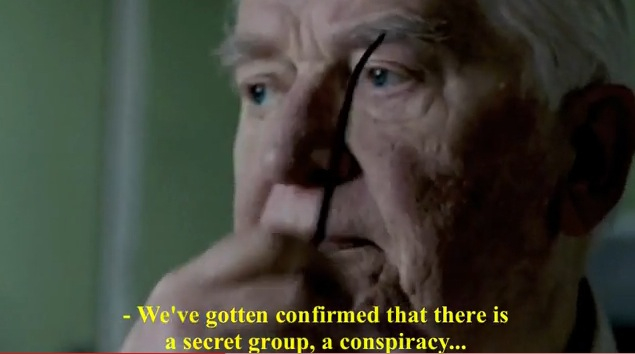
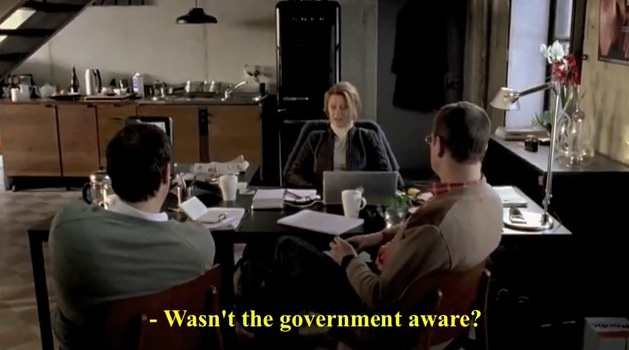
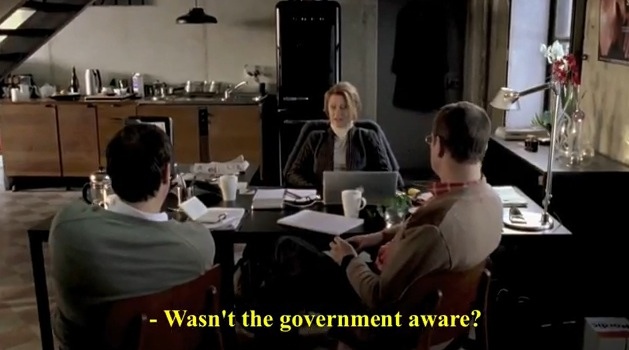
Scene from the film "The Girl who Kicked the Hornet's Nest" - the third book of Stieg Larsson's Millennium Trilogy.
Meanwhile, I wonder whether the accusations of rape that have been made against Assange in Sweden are just an attempt by his enemies to put him behind bars. It would not be the first time that the Swedish authorities were accused of falsifying evidence to imprison an undesirable element linked to computer hacking, violence against women, espionage and the security services. Stieg Larsson‘s Millenium Trilogy are works of fiction, detailing how corrupt elements within the Swedish secret services conspire to frame the heroine Lisbeth Salander, and keep her locked up, so as to save their own skins. Salander, like Assange, is a computer hacker who takes on and challenges authority. It would be ironic if the Swedish accusations against Assange also turned out to be false – and were an attempt by his enemies to put him away. However such things only happen in fiction…. don’t they?
Scene from the film "The Girl who Kicked the Hornet's Nest" - the third book of Stieg Larsson's Millennium Trilogy.
More thoughts on Asia & Sarah Palin on North Korea!
I didn’t really want to discuss the recent spat between North and South Korea. I know too little about it. However I do know that there is likely to be a leadership change shortly, when Kim Jong-Un takes over from his father Kim Jong-Il and that North Korea is the only remaining Stalinist Communist state. I also know that South Korea is currently an ally of the United States.
That may all change in 2012, if Sarah Palin gets elected, based on a recent radio interview in the USA, where Palin described the North Koreans as US allies. Of course it could have been a slip of the tongue. However it won’t be the first slip of the tongue where Palin has shown ignorance of the world outside Alaska.
Listen to the Sarah Palin radio interview:
The problem is that too many Americans wouldn’t know the difference between North and South Korea – and many would love to go back to the isolationist days of 60+ years ago. They fail to realise how interconnected the world now is – and that any President, or potential President, has to have an acute awareness of America’s place in the world and global geo-politics.
I’m sure that some people will say that this is the role of the President’s advisors. If that is the case then elect the advisors – as it’s the President who signs the policy and agrees to it, and not the advisors. A President who has insufficient knowledge to be able to assess the advice given is not going to be effective or even safe. Instead of a slip of the tongue, the world will be at the risk of the slip of a button on the nuclear trigger if an unelected advisor has their own political agenda. That is a real danger with Sarah Palin, should she get elected. Palin believes that all that is needed is “common sense” and she puts down high-level (Ivy League) education. This is a problem for the USA and the Western World. In today’s world, lack of education means failure and avoiding this is a key reason why education is so important for the emerging super-powers, India and China, where there is an emphasis on self-improvement and knowledge.
Ironically, before hearing the news about Palin’s latest gaffe, I’d been reading Jon Lowder’s Blog post about an anti-elitism that’s sweeping America, and symbolised by Palin. It’s not wealth that’s seen as evil, but knowledge. Lowder quotes from a column by Frank Rich in the New York Times, discussing whether Palin could become President.
It’s anti-elitism that most defines angry populism in this moment, and, as David Frum, another Bush alumnus (and Palin critic), has pointed out, populist rage on the right is aimed at the educated, not the wealthy.
This disdain for knowledge and education is the way back to a new dark age – or perhaps, a new future, where America renames itself as Gilead (and Margaret Atwood‘s dystopian vision in her novel The Handmaid’s Tale becomes reality).
Thoughts on Asia
A week ago I was travelling – first to Jakarta in Indonesia and then on to Mumbai in India. I left Jakarta just as President Obama was arriving, and flew to India where he’d spent a few days before moving on to Indonesia.
I’d never been to Indonesia before and hadn’t been in India for a few decades so my take on both countries may be subjective. However there were some things that were impossible to ignore.
In both hotels I stayed in, security was high. I had to pass my luggage through a scanner and pass through one each time I entered the hotel. The same applied to a shopping mall I visited in Jakarta. I’m familiar with this in Israel – and expect it. It’s the way to protect public places from terrorist attack. I was not surprised to see it in Mumbai, considering the atrocities carried out over the last few years in India. However I was surprised to see it in Jakarta – the largest Muslim nation in the world. I know that there was an attack in Bali in 2002 but Bali was a target as it was a way to hit so-called decadent Westerners (or so I thought). Jakarta, conversely, is a business centre and unlike Bali, mostly Moslem. Yet, security was tight – and it wasn’t just because Obama was visiting.
In London there is no overt security in hotels – you walk in without being stopped. The same applies in mainland Europe (or at least in the countries I’ve visited recently) and in the USA. However I suspect that over time, this will change as the terrorists inflict their damage on the ways of life and the freedom we expect. The plague that is terrorism does not distinguish between nations and religions – and it is ironic that so many terrorists claim to be followers of Islam, yet still target Moslems, as was so evident in Indonesia.
 Jakarta - Rich versus Poor: A bank next to a street merchant. |
Another thing I noticed – especially in Indonesia was the gap between rich and poor. My hotel – a beautiful five-star hotel – was directly outside a road packed with shacks and small roadside shops. I took a walk down a lane – that would have been a downmarket slum in London. The lane joined the Intercontinental hotel that I was staying in, and the Shangri-La that Obama was booked into. Although I felt safe, I could see how resentment over the wealth that was so visible compared to what the majority survived on could spill over and destabilise the country. Whether this will happen, of course, will depend on the efforts the government makes to close the gap and allow the aspirations of the majority to be fulfilled. Without any effort I foresee trouble within a few years – either via violence, or political upheaval. Either will not be pleasant for those with the money, and potentially for those without. |
In contrast, in India, even though I saw poverty, I also saw hope. People smiled and looked happy – even those with almost nothing. Children played cricket on the streets and there wasn’t the poverty of spirit you see in the West. Instead, there was an optimism that I’ve also seen in China but you need to search for in the US and Europe.
 A Mumbai Street Scene - Night-time cook-out on the pavement. |
 Children playing Cricket In the Street in Mumbai - perhaps why India is now better than the UK at Cricket, as kids still play actively outdoors. |

Go to AWARE's web-site


 Competitive Intelligence News
- Lifesight Launches Mia Marketing Intelligence Agent - Let's Data Science
- Lifesight Launches “Mia,” an Agentic AI Marketing Intelligence Agent - Yahoo Finance
- Data for growth - Part 4: CRM data enrichment: Sales and marketing intelligence with AI - Moody's
- Tonic Worldwide launches ‘Groth’ an AI-Powered Marketing Intelligence Platform built to deliver Answers, Not Just Data - MSN
- Maverick Marketing Intelligence Competition - Spring 2026 - The Shorthorn
- Five Findings About Today’s Market And Competitive Intelligence Programs - Forrester
- My ‘detective’ job as a competitive-intelligence consultant for pharma - Nature
- Sales Teams Lose Competitive Deals Without Disciplined Competitive Intelligence, According to Info-Tech Research Group - PR Newswire
- AI Ad Generator for Facebook With Real-Time Competitive Intelligence Launched - The Norfolk Daily News
- Marketing Intelligence Adds Value to Growth Partnerships: Nielsen’s Peter Naylor - Beet.TV

 Find It Out - Research Secrets and More