Archive

Archive for the ‘News stories’ Category

Reading the news

June 18, 2010 Leave a comment

In 1979 I visited Turkey for the first time. I like Turkey – it’s a great and beautiful country with lots of history. It also shows how Islam and extremism don’t go hand-in-hand and how an Islamic country can also be a liberal democracy. Like all free countries, it has its share of extremists who spout forth nonsense that would guarantee a jail sentence or death in the autocracies that govern most of the world. However that is not what this post is about – although Turkey is the seed for the post.

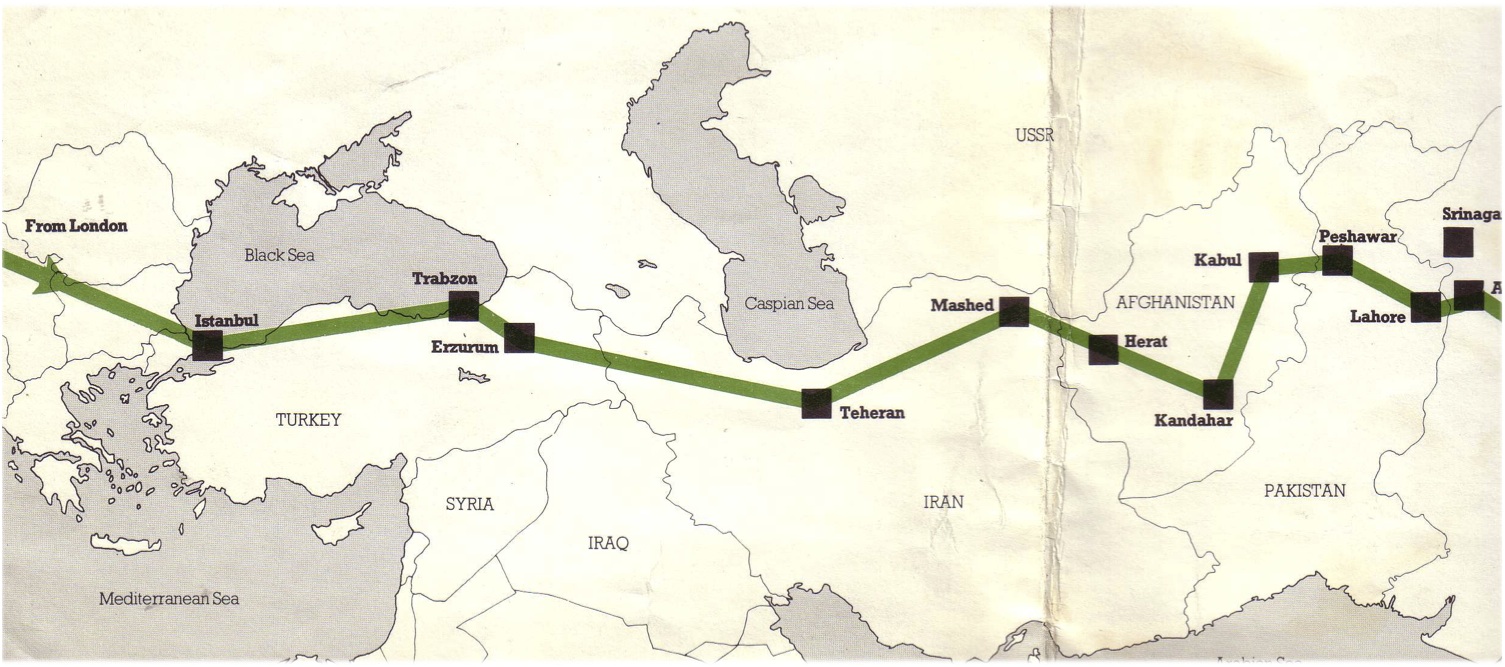
It was August 1979, and I was backpacking, staying in cheap hostels. A standard item of conversation back then was whether it was safe to travel through Afghanistan on the overland route to India. Turkey was one of the first stopping places on this route that travelled through Iran, Afghanistan, Pakistan and on to India.
From a 1970s Trailfinders brochure showing suggested routes to India
Travellers were talking about the attacks on tourists journeying through the country and how some tourist buses had been shot at.
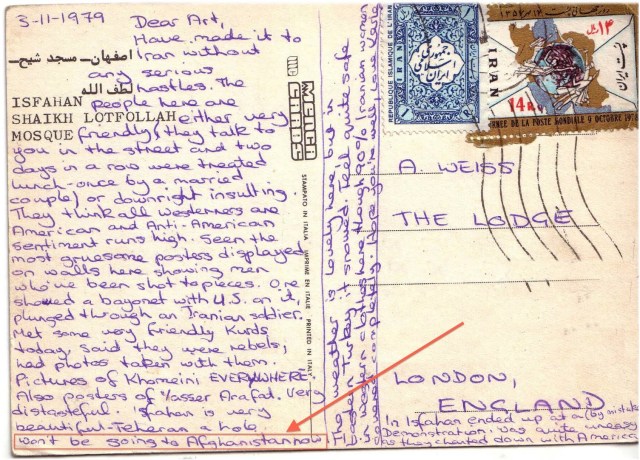
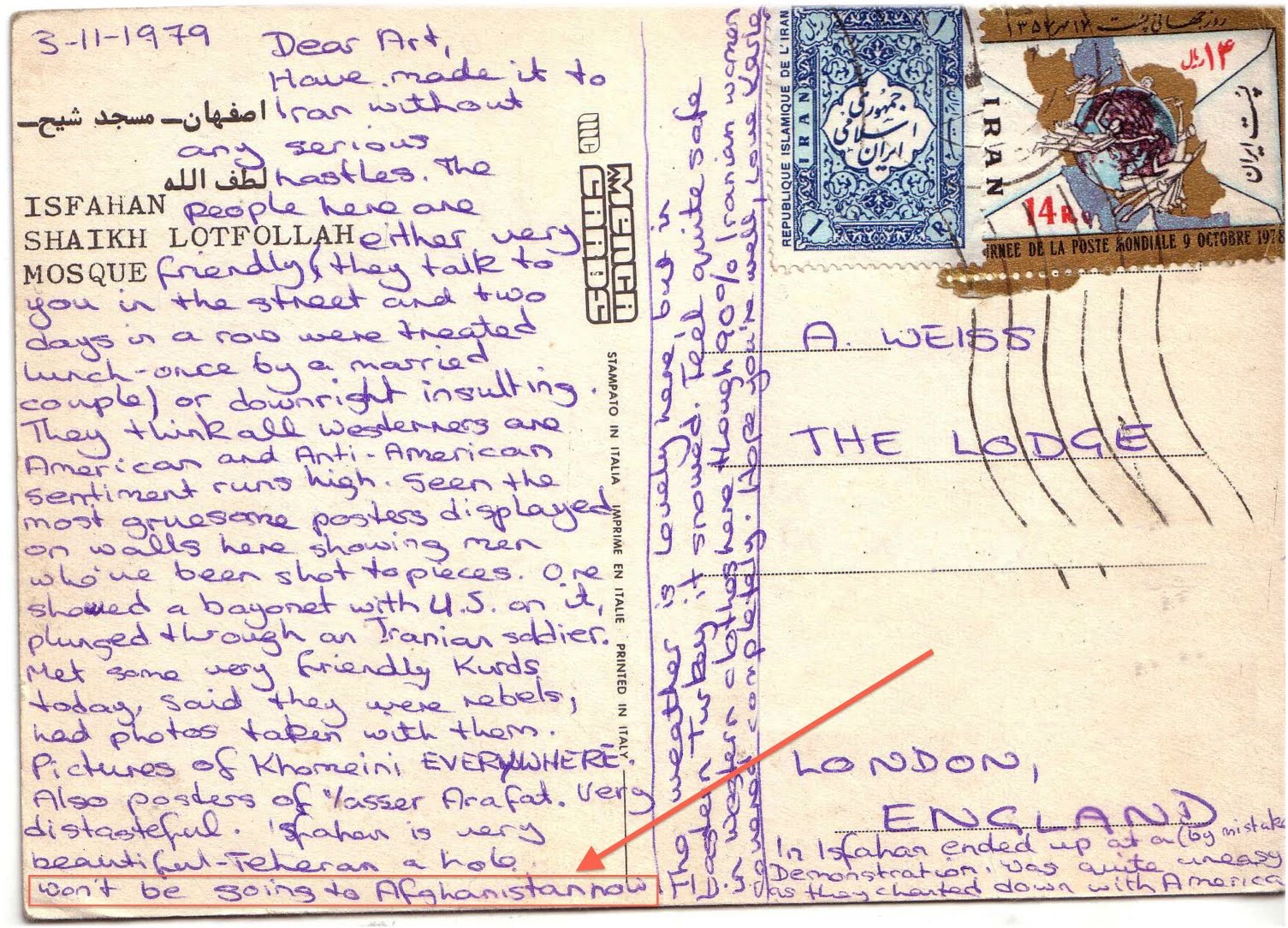
A postcard sent to me by a friend I’d met when travelling through Europe who wanted to go on the overland routes to India. Karla had hoped to go through Afghanistan but as I’ve highlighted, felt it wasn’t safe. This postcard was sent the day before the Iran hostage crisis and shows the atmosphere in Iran at the time.

I knew nothing about Afghanistan at all and when I got back to the UK started to read up. There was very little in the press – and certainly no headlines. However reading between the lines, I realised that not only was there a civil war going on, but that this was threatening the Southern borders of the Soviet Union. The situation was unstable and something had to happen.
Over Christmas in 1979, Soviet tanks rolled into Afghanistan with the aim of bringing back order to the country. The Soviet aim was not to colonise the country but to prevent the ferment from spreading and leading to sectarian movements on the Soviet borders. However that is not how the world, led by the USA saw things. This was the time of the cold war. Any way that the West could score points against the Soviet bear was legitimate. The initial response was massive anti-Soviet propaganda, ignoring the initial context. Later on, the US funded the Mujahaddin fighting against the Soviets, including Osama Bin Ledin – a case of the enemy of my enemy is my friend.
My response however was different. I saw that the Soviet incursion had been an obvious solution to a problem that they faced, and that the correct approach was to treat it as such, rather than as a global problem. Afghanistan had been a flashpoint that the world had seemingly ignored. It led, eventually, to the break-up of the Soviet Union, when it became impossible to hide the costs in both lives and money by the secretive Soviets. I believe that Perestroika and the 1991 fall of the Soviet Union was partially a result of the Soviet’s Afghan adventure.
The point of all this is that newspapers publish
  1. what their editors view as of interest to their readership
  2. news when they have sufficient information for a story.
This is important for competitive intelligence, business analysis and common sense. Without this realisation people are likely to jump to incorrect conclusions based on what they read. The only way to read a newspaper is to question each story and ask why it was published – to understand the hidden agenda.
When there is insufficient information or where it is dangerous for journalists to publish a news story, then however potentially important that news story is, it won’t get published. That is why so few bad news stories highlighting lack of freedom, atrocities and so on are published on the autocracies that rule much of the world. Instead, news focuses on countries where there is a relative freedom to publish, and journalists can report on what is happening unimpeded by the authorities.
If something is not fashionable then it won’t be published or what is published will correspond to what people want to read. This is the case with much reporting on Israel. Israel is now seen as a “shitty little country” (as described by a former French Ambassador to the UK). It’s definitely not fashionable to support it – despite the fact that it is the only full democracy in its region with a free and functioning press, Arab parliamentarians, and equal rights for all its citizens. It has also been at war for over 60 years – with its enemies being countries that, in general, are totalitarian and that imprison, torture and execute dissenters. It has been attacked with missiles fired daily at its cities, yet is lambasted when it responds – most recently by blockading the territories from where the missiles were fired (Gaza). Israel is condemned for trying to protect its citizens and for fighting a territory ruled by a group, Hamas, that is viewed as a terrorist group by Western countries, including the US, the EU, Japan and Canada.
In contrast to the situation in Israel – where every action is microscopically analysed and hits the headlines, much less appears on newspaper front pages and as headline news about the very recent massacres of Uzbeks in Kyrygyzstan. Virtually nothing came out about the Syrian destruction of the city of Hama in 1982, in contrast to the blanket reporting of the events at Sabra & Chatila in the same year. Even in this case, Israel is blamed for the actual attacks while in reality the massacre was carried out by Christian Phalangists in revenge for earlier attacks on them by the Palestinians. The reason for all these examples is that much less information was available from Syria and Kyrygyzstan. Both countries don’t have the free press that Israel has, and in both cases, publishing such news could lead to the journalists being arrested, and probably tortured or killed. As a result very little is seen.
The same selectivity appears in the business press too. Currently BP is under the spotlight for its responsibility for the US oil spill. Although I’m sure that BP bears much of the blame for this disaster, very little has been written about the other companies involved including Transocean and Halliburton. Although BP was the largest shareholder in the well, Texas based Anadarko Petroleum owned a quarter and the Mitsui Oil Exploration Company via its MOEX Offshore subsidiary owned 10%. Transocean owned the rig and of the 126 people working on the rig, 79 were Transocean employees (against only 7 BP employees). Halliburton cemented into place the casing for the well that blew. In fact, the other companies bear some of the blame – if only by not ensuring that best practice was followed and allowing BP to cut corners (if that is what happened). The US regulator, the Minerals Management Service, that had approved the well should also shoulder some responsibility.
It is now fashionable to attack BP – with President Obama (showing an anti-British prejudice), referring to the company as British Petroleum, when the correct name has been BP for many years, reflecting the fact that more of its employees are American than British (BP has 23,000 US employees and under half that number of British employees. Of its 9 senior executive members there are more non-UK members than UK ones with four US positions). The problem is that sometimes it is better for those in power to hide the truth – whether they run a company or a country.
Competitive Intelligence means looking behind the news and doing an analysis to find the truth. That is not the role of newspapers. Their role is simple: to sell and make profits for their owners. If that means subjective reporting, then so be it. Fortunately the quality press sometimes does publish unfashionable news stories and carries out independent analysis. An excellent recent example is an article by Jose Maria Aznar – the Prime Minister of Spain between 1996-2004. Aznar writes (in the London Times – 17 June 2010) about Israel and how failure to support Israel threatens Western values overall. He states that the Gaza episode “is a distraction” and that “Israel is the West’s best ally in a turbulent region“. A shame that there is not more analysis of this type. As this is what true objectivity involves.
Proof of Aznar’s thesis can easily be found. For example, a recent Twitter tweet lamented the loss to the Moslem world of Andalucia, and advocated the route of the martyr, and reaching for life in the hereafter in preference to life in this one.

@Jnoubiyeh the second we lost andalus we lost dignity. wars came 2 remind us again. We lost it was when we chose this life over hereafter

Unfortunately publicising such views are unfashionable and often suppressed – so instead we draw incorrect conclusions and victimise the victim (e.g. Israel) and praise the oppressor (e.g. Hamas).
A tale of two countries

December 18, 2009 Leave a comment

I’ve just read the story of James Bain who was freed after DNA evidence proved that he was innocent. Bain was apparently convicted on the evidence of a line-up despite other evidence not linking him to the crime he was accused of. Of course Bain is not white – and so the US justice system – certainly that from 35 years ago – was prejudiced against him.

Contrast this to the cries against the Italian justice system that has just convicted an American citizen and her Italian boyfriend of a brutal murder – also based on DNA evidence. In the case of Amanda Knox and Rafaelle Sollecito it wasn’t just DNA evidence either. There were bloodied footprints, erratic behaviour post-murder with changing and inconsistent stories, evidence of antagonism between Knox and her victim, plus more.
Too often, the American legal system seems prejudiced against those least able to defend themselves – look at the differences in the ethnicity of people sentenced to death versus those who escape a capital sentence.
Now contrast this to the Italian legal system where a white, affluent Italian, and his white affluent girl-friend were treated equally to Rudy Guede, a black Ivory Coast accused – sentenced earlier.
The only bias here is not the Italian legal system but the Americans who believe that you can only get justice in the USA, and that the Italian legal system and the judgement is flawed.
If this was the only example of hypocrisy emanating from the US it could be excused – but unfortunately it isn’t. Another example is the US “justice” system’s hounding of Gary McKinnon – an Asperger sufferer who has been accused of exposing weaknesses in US military computers and so has to be sentenced so that those who failed to protect the system can get off free.
So what has this to do with competitive intelligence? Maybe nothing – on the surface. However if you think about, a lot. As it shows how important it is to remain objective – unlike with Gary McKinnon; to avoid prejudice – as was shown with the Bain case and also the objections to the Knox case; and to ensure that there are multiple lines of evidence before coming to a conclusion and making a decision – as in the Knox case but not in the Bain case.

Thoughts for 2008

February 5, 2007 Leave a comment
It may seem like we’ve only just started 2007 – after all it is still only February. However marketers should be thinking ahead, and it’s never too early to start. After all January 1st 2008 is less than 330 days away and the US presidential elections, taking place on November 4th, 2008 are under 650 days away.

So what can we expect for 2008 – which we should be planning for today!

1) There will be a US presidential election – and the winner will not be George Bush. It may be a Republican colleague – I’m not going to forecast who I think will win. Or it may be a Democrat. Whoever wins will want to show change – and will want to be seen as their own man or woman. (Yes – woman. As this election promises to be significant in that Hillary Clinton may become the Democrat nominee – meaning that for the first time, there will be no First Lady, just a First Man, to accompany the First Female President of the USA.)

So political change in the US is inevitable. This will have an impact on all aspects of life both in the US and the world.

2) In the UK, Tony Blair will be just a memory and history. He’s announced that he will be standing down this year. 2008 will be the year his successor will start making the changes that will gear up to the next UK general elections which must take place before June 2010. If Tony Blair’s successor fails to win hearts and minds, then they will not survive and it takes at least a year for this to happen. So 2008 will be the make or break year.

3) Globally, the Iraq war will still not be sorted out – and deaths from bombings and terrorism will continue. Whether the USA and UK will still be involved is less clear – although my bets are that both countries will still have forces in the country.

In fact, I suspect that the situation today in the Middle East will still be broadly the same. The Israel-Palestine conflict will still be a dominant factor – although I think that the leaders in both Israel and the Palestinian authority may be different. I’d like to say the same for Iran – but even though President Ahmadinijad (don’t you think this sounds a bit like “I’m a Dinner Jacket”) may be highly unpopular globally and even among many of the intellectuals in Teheran, he won’t be ousted unless the Mullahs and the masses turn against him.

I’d also like to see President Mugabe of Zimbabwe go. Again, this is unlikely – unless he dies of old age. I don’t see him stepping aside, despite the dire straights his country is now in. And Mugabe will continue to blame Britain and the West rather than accept that he has destroyed what was once a flourishing and successful economy.

4) In the information / computer world – Vista will become the dominant operating system, not due to its quality but purely due to inertia. People will be dithering in 2007, but by 2008 will feel that they need to upgrade their PCs – which will all come pre-installed with Vista. However there may be small changes.

It is possible that in the home market, people may start thinking about Macs – especially if Apple‘s marketing succeeds in emphasizing the Mac as a better computer for the home in contrast to the PC for the office. The iPod effect may help drive this, as well as the aspirational aspects of the new iPhone which will start being seen in people’s pockets. Meanwhile in the world of the web, many of the Web 2.0 applications will be seen as mainstream – possibly with a new killer application taking pole position. Google will, however, still be the dominant search engine although I believe that it will have lost share to others – both newcomers and perhaps Windows Live and Ask.

I’ve not mentioned other areas that I think will be important – the threat of climate change for example will lead to increased demands to control carbon emissions, and flying may start to be seen as a luxury if taxes increase to make airlines responsible for their carbon footprints (although I somewhat doubt this will come in by 2010). I think that predictions that 2007 will be the hottest year ever will, if they come true, lead to an international effort to prevent global warming. However unless China and India come on board not much will be done, so I feel that any major changes won’t occur in 2008. If they do, then the impact on economies will be “interesting“!

Finally terrorism will still terrify – increasingly, as the prospect of mega-terrorism comes to the fore, with terrorists gaining (or being prevented from gaining) nuclear or biological material. The war on terror will not be won until all countries perceive the threat equally and stamp down hard on this scourge. Currently many just play lip-service to the concept in the hope that by keeping their heads down they won’t get targetted. However that is not how the terrorists see them. They see them as soft and ripe for take-over, as that is the ultimate objective: to make the world follow their particular concept of God!

Moonwatching – Google goes out of this world!

July 20, 2005 Leave a comment

Just visited Google, and saw that today (20 July, 2005) is the 36th anniversary of man landing on the moon – the first extra-terrestial tourist walkabout.

Take a look at the moon map – and for another example of Google’s humour zoom in on the map (I can’t bring myself to call it ElGoog!). The result is really cheesy! (http://moon.google.com). (And of course this is another reason why Google is pre-eminent in the search engine world. Google is a great example of a company that encourages lateral thought – so that all staff think differently and rather than fall into a rut of mediocrity, continually try and come up with new ideas. Some may be oddball, some objectionable, but many will help enhance our web experiences. That is what marks a great company: a company that is satisfied with itself – while at the same time willing to push the frontiers of what is possible, without fear that eccentricities and failures will be penalised).

It seems strange to think that man first landed on the moon so long ago. I was still at school but remember the occasion vividly. It was an example of all that is best in mankind. Adventure, bravery, challenge, daring, excitement, fearlessness…. yes I could cover the whole A-Z! Yet by 1972 the dream was fading – and moon trips stopped.

The world today is completely different to that of 1969 with its hopes of peace, as symbolised by the One small step for man, one giant leap for mankind speech as Neil Armstrong and Buzz Aldrin disembarked from the lunar module. Just think about how different the world is today: no more cold war, the fall of the Soviet Union, medical advances that were dreams back in 1969, instant communication (mobile, Internet) – the average computer in 1969 was probably less powerful than the credit card sized calculator given away as a freebie at many of today’s trade shows. Yet – the promise of peace is still as elusive; the world may seem smaller, but the cold war was replaced with other ideologies that still separate us from recognising that we are all part of a global community living on the only planet we know that can support human life.