Archive
Wikileaks and Whistleblowing!
“As soon as Joseph saw his brothers, he recognized them, but he pretended to be a stranger….” (Genesis Ch. 42 v7).
“There is a time for everything, and a season for every activity under the heavens….a time to be silent and a time to speak….” (Ecclesiastes Ch 4 v1, v7)
I wasn’t planning to write about the Wikileaks affair – as in essence, I agree with Wikileaks that excessive secrecy is wrong. At the same time, as the preacher (identified with King Solomon) in the book of Ecclesiastes says, there is a time to speak out, and a time to remain silent.
I believe that many of the items leaked deserved to be leaked. It is wrong to keep details of torture, rape, summary executions, and various other war-crimes secret, irrespective of whether such crimes were committed by the USA, the Iraqis or whoever. War-crimes should always be exposed, and prevented. If a government tries to keep such crimes hidden, then it is the duty of responsible people to expose them. Keeping such information secret just allows for a culture that views the enemy as non-human and dispensable – and ultimately, this makes all who allow this to happen complicit in the crime.
At the same time, there is good reason to keep diplomatic negotiations hidden, however duplicitous they may appear to be – so long as there is a procedure to ensure that such records are not kept secret permanently, but are released when they are no longer politically and diplomatically sensitive. Similarly, information that could put lives at risk – through the identification of people who oppose an oppressive government or who collaborate with others to end oppression – is totally wrong.
Essentially, a leak to prevent wrong-doing is, in my view, correct, whereas a leak for some warped belief that everything should always be out in the open and public is wrong. Whistle-blowing to prevent corruption and criminal activity is right – whether it impacts commercial or government business. There is a time to speak out, and a time to keep silent, as in the biblical story of Joseph. Had Joseph identified himself when his brothers first visited him, he would have been unable to test their sincerity and repentance. It was important that he kept his status secret – in the same way that it is important that diplomatic cables shouldn’t be revealed as a general rule.
Sarah Palin & Mike Huckabee enter – stage right.

Sarah Palin
One reason I’d avoided discussion of Wikileaks was that Sarah Palin had just commented on the site. Having just written a blog post on her, I didn’t want to reprise some of my comments. Her view that Julian Assange, the founder of Wikileaks, should be hunted down “with the same urgency we pursue al-Qaeda and Taliban leaders” is yet another emotive, and ill-reasoned Palinesque comment showing a lack of understanding of what al-Qaeda stand for and what the Taliban represent. Assange may have caused damage to USA interests but in no way can he be seen as an overt enemy who would like to destroy everything that the USA stands for, and to impose a totalitarian belief system on the world.
However along comes Mike Huckabee who, apparently, does not wish to be outmanoeuvered by the outspoken Mrs Palin in his dreams of entering the White House. Huckabee has called for the execution of the person accused of leaking the material to Wikileaks.

Bradley Manning
I agree that the man accused of leaking the material, Private Bradley Manning should be tried and if found guilty, punished (assuming that the trial is fair, which now with so much negative press is doubtful). I do not agree that he deserves the death penalty. He did not release the files to an enemy government and nor did he do it for cash rewards. According to reports he did it after seeing attempts to cover up possible war-crimes committed by the US – for instance an air-strike that killed a dozen people in Baghdad and where the air crew laughed at the dead, and another in Afghanistan, that killed dozens of children. This makes him a whistle-blower and not a spy or traitor, and as such, this needs to be taken into account in any penalty. An overly severe or unwarranted sentence will just serve to further deter whistle-blowing and allow corrupt officials, politicians or business managers to continue in their actions.
I also question whether it is Manning alone who should be blamed. The US government must share some blame in not protecting material they viewed as confidential. Apparently the material leaked was available to many thousands of people. Following the September 2001 terrorist outrages an attempt to stop the silo mentality that had prevented different bits of information being linked together, correctly allowed for improved sharing of intelligence. Evidently such sharing did not consider the security implications of making so much information available to so many – with minimal protection. If Manning had not leaked the material, I’m sure that somebody else with a moral conscience, seeing the Iraq video, would have.
Additionally, it was not Manning (if the leak came from him) who posted the material but Wikileaks. Wikileaks would like to be seen as a channel whereby whistle-blowers can alert the world of crimes (commercial or governmental) that are being kept hidden, and I believe there is a need for such a service. Had they fulfilled this role, they would have edited out any material that did not serve a public service in being released.
The free-rights-for-all crowd enter – stage left.

Facebook Group Logo for Boycotting Amazon over Wikileaks
Wikileaks, trying to remain online, used Amazon’s hosting service for the site. Of course, Amazon was then criticised for ostensibly supporting the service, and came under pressure to boot the service. Had they not done so, I’m sure that they would have faced a large and damaging right-wing campaign against them – especially as the peak holiday buying season approaches. Their action however has, instead, led to a call for a boycott from those who believe in total freedom of speech regardless of the content, including a dedicated FaceBook fan page.
Had Amazon not hosted Wikileaks in the first place, neither side would have complained. Instead, Amazon has been criticised from both sides for doing what it felt was the right thing – both commercially and morally. They hosted the site – I’m sure because they believe in the moral principle of Freedom of Speech. It was not just a commercial decision – as I don’t believe that you will find any Nazi or Ku Klux Klan sites on Amazon servers. They host sites that they believe are not objectionable to their ethos. When, in the case of Wikileaks, this then threatened to be commercially damaging, they pulled the site – and get blasted by the “Freedom-of-Speech-at-all-costs” crowd who I’m sure would quickly campaign against the company if Amazon took this literally and started hosting racist, Nazi or kiddie-porn sites.
Julian Assange and Wikileaks
Wikileaks is not the first whistle-blowing web-site. My favourite – www.fuckedcompany.com – has unfortunately shut down, along with its sister site www.internalmemos.com. These two sites were important in warning investors of commercial shenanigans and companies that were having problems. Unfortunately I know of no other good sites offering such services. Wikileaks could, and should, have taken on this role. However with Assange as their editor-in-chief, they seem to be looking for headlines and controversy rather than fulfilling a role in preventing corruption and crimes being committed by both government and commerce.
Julian Assange. (Is it just me who thinks that Assange has a strong resemblance to Lucius Malfoy in the Harry Potter films? He just needs to grow his hair a bit longer and they could be twins!)
Assange, according to Wikipedia, has led a peripatetic life. He claims to be constantly on the move – starting from his childhood, where his mother, in conflict with his father, hid Assange and his half-brother for five years. Obviously very bright, Assange became a leading computer hacker at the age of 16, and claims to have studied at university level, physics, mathematics, philosophy and neuroscience.
In 2006 he founded Wikileaks with an overtly political aim of encouraging leaks to change organisations that he felt were unjust or secretive:
…the more secretive or unjust an organisation is, the more leaks induce fear and paranoia in its leadership and planning coterie…
Prior to the current 2010 leaks, WikiLeaks has published material relating to extra-judicial killings in Kenya, information on toxic waste dumping off Africa, Church of Scientology manuals, a report on share price manipulation (that led to criminal charges and a jail sentence for the culprits) by the Icelandic Kaupthing Bank and many more reports and items.
What next?
The latest leaks have caused severe embarrassment for the USA and many of its allies. Worringly, the response by some of the opponents to Wikileaks show how freedom in the USA is at risk. Rather than accept that their security was lax and that the leaks show signs that illegal practices are being covered up, blame is being pinned on the message and the messengers (Manning and Assange). That is not to say that either are totally innocent. Manning, if he was responsible for leaking all the documents was naive to say the least. Assange strikes me as a petulant, spoilt and amoral man who loves the publicity he is getting, and doesn’t really care who gets hurt in the process.
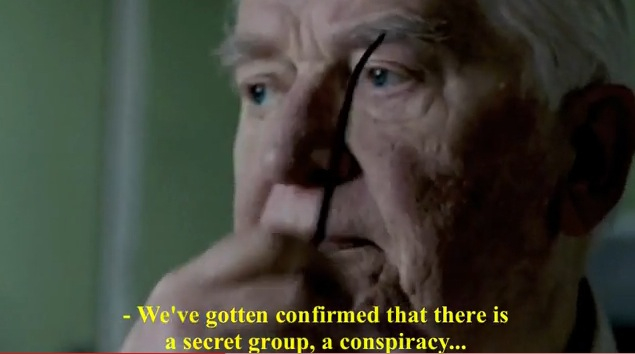
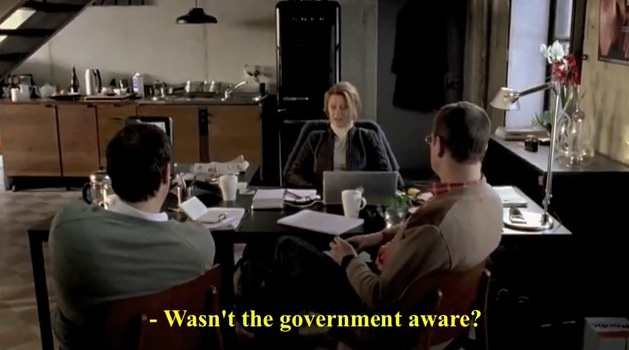
Scene from the film "The Girl who Kicked the Hornet's Nest" - the third book of Stieg Larsson's Millennium Trilogy.
Meanwhile, I wonder whether the accusations of rape that have been made against Assange in Sweden are just an attempt by his enemies to put him behind bars. It would not be the first time that the Swedish authorities were accused of falsifying evidence to imprison an undesirable element linked to computer hacking, violence against women, espionage and the security services. Stieg Larsson‘s Millenium Trilogy are works of fiction, detailing how corrupt elements within the Swedish secret services conspire to frame the heroine Lisbeth Salander, and keep her locked up, so as to save their own skins. Salander, like Assange, is a computer hacker who takes on and challenges authority. It would be ironic if the Swedish accusations against Assange also turned out to be false – and were an attempt by his enemies to put him away. However such things only happen in fiction…. don’t they?
Scene from the film "The Girl who Kicked the Hornet's Nest" - the third book of Stieg Larsson's Millennium Trilogy.
Share this:
- Click to print (Opens in new window) Print
- Click to share on X (Opens in new window) X
- Click to share on Facebook (Opens in new window) Facebook
- Click to share on LinkedIn (Opens in new window) LinkedIn
- Click to share on Pinterest (Opens in new window) Pinterest
- Click to email a link to a friend (Opens in new window) Email
- More
We were duped – EMI, Terra Firma and its argument against Citigroup
“We were duped – Terra Firma closes its argument against Citigroup” (news item available to subscribers only) is the headline in the London Times (3 November 2010) reporting on Terra Firma‘s case against Citigroup relating to its 2007 purchase of the music group, EMI (which they lost).
I’ve been watching this news story, and EMI, for a number of years – as an example of a classical competitive intelligence failure. In fact, it’s not just one – but two failures. The first is the failure of the once great company, EMI, while the second is the failure to check sources and do appropriate due diligence, by Guy Hand’s firm, Terra Firma. As a case study in business failures, I believe it is a classic.
EMI’s history dates back to the early days of recorded music and it was once at the pinacle of its industry. Artists on EMI labels included The Beatles, Pink Floyd, Queen, Kylie Minogue, Coldplay, Lily Allen, KT Tunstall, Robbie Williams, and many many more. I grew up listening to albums such as David Bowie’s “Ziggy Stardust“, the Beatles “Sgt. Pepper’s Lonely Heart’s Club Band” and the unforgettable “Dark Side of the Moon” from Pink Floyd (the latter during free periods in my last year at school – that dates me 🙂 )
However EMI never adjusted to the idea of music downloading and the Internet. Rather than accept that there was a new technology that meant that the old model was dead, it tried to use court case after court case to kill the emerging hydra. Rather than fighting peer-to-peer online sharing of music it should have seen it as inevitable and that this reflected a new way for distributing music.
Music sharing was not new. People would regularly tape records and CDs – and although this was a problem for the recording companies, it was usually small scale and so could be overlooked. Even if one person didn’t purchase a record, their friend had. I believe that many records would be purchased just so you could hear a decent recording – rather than the bootleg taped version, so this copying served a purpose by publicising the music.
The Internet changed this – especially when services such as Napster emerged. The view of companies such as EMI was that such services had to be smashed – and that the old models had to be preserved. This did not mean that there were no new approaches that could have been adapted, and that they had no choice: there were. Last.fm, Pandora, Spotify, boxee and iTunes are all examples of services that take account of the web, online music streaming and similar to make money (albeit not all have yet broken into profit). Each of these offers a new model for distributing music – via low-cost downloads (iTunes), to subscription services (with a mix of free and paid versions) such as Spotify – backed up by advertising. Had EMI investigated such options the problems that led to its failure and eventual sale may have been avoided.
This is the first competitive intelligence failure and lesson.
Competitive Intelligence doesn’t just look at competitors. It also looks at the competitive environment and attempts to anticipate business change. It assesses the business change – and looks at the implications, allowing decision makers to develop strategies that cope effectively with the change. EMI certainly recognized the change represented by the Internet, but failed to understand its significance and so failed to adapt to what should have been obvious i.e. that the Internet was a radical change rather than an evolutionary development.
Such change occurs periodically – but always has a massive impact on businesses that fail to adapt their business model. Classic examples include the
- development of commercial flight on shipping – why spend days sailing across the Atlantic from Europe to the USA when you can fly?
- electric light – much safer and better than gas lights or candles
- internal combustion engines and especially the mass production of cars, as initiated by the Ford motor company. The horse and cart, and all the equipment linked to horse and cart transport lost out.
The Internet was another such development. When such events (sometimes called Black Swan events) occur, only companies that recognise the threat and adapt quickly survive. EMI has failed in this – trying to stop the new models for music distribution, rather than embrace them and look for ways to make money from them.
Then we come to Guy Hands and Terra Firma’s acquisition of EMI. This is the second competitive intelligence failure – and in my view the more serious, as Terra Firma should have known better.
Private Equity firms such as Terra Firma’s make their money by buying and selling other businesses. Before purchasing a business, they need to do due diligence so that they can assess what they are buying.
Terra Firma’s court case revolved around a claim that they were mislead by Citigroup into believing that another company, Cerberus, was also bidding for EMI. They apparently were not told that Cerberus had dropped out on 19 May 2007, and so rushed through the due diligence process to ensure that they remained the prime bidder. Terra Firma claimed that David Wormsley, a Citigroup banker, had told them that Cerberus planned to place a rival bid of 262p a share and so Terra Firma offered 265p and walked away with what they thought was their prize.
Essentially there were three mistakes made here. The first was believing a single source without attempting to verify it through standard competitive intelligence approaches i.e. was Cerberus still bidding? Terra Firma relied on the word of a single individual whom they trusted, but who had a vested interest in upping the price that would have to be paid.
The second mistake was even worse. By rushing through their due diligence they didn’t investigate sufficiently the state of EMI and whether it was actually worth what they ended up paying. In fact it should not have made a difference whether or not Cerberus was bidding – if the company was not worth the price being asked then it would have been better to let a rival bidder grab it. Failure to do the due diligence meant that this assessment was not done effectively – it seems that Hands was blinded by his desire for EMI and wasn’t interested sufficiently in the process of ensuring that he got the value from his money.
The third mistake was hubris – instead of learning a well taught lesson, Hands attempted to blame Citigroup for being mislead, ignoring the old rule of Caveat Emptor . Had Terra Firma won, it would have meant that any advisor in any business sale would be at risk of being sued by purchasers who for whatever reason, failed to do adequate due diligence, and instead trusted totally the word of their advisors on what was or was not a good buy. Fortunately the court saw otherwise, and said good bye to Terra Firma’s claim.
In a way, the date of the judgement against Guy Hands is ironic – as 5th November is known as Guy Fawkes day in the United Kingdom. Guy Fawkes attempted to blow up Parliament in 1605. Instead of Trick-or-Treat on Halloween, British children used to make an effigy of Guy Fawkes to be burned on Guy Fawkes night, along with fireworks. Traditionally they would then use this effigy to collect money, with the chant “Penny for the Guy“. This 5th November that slogan will have a new meaning for Terra Firma and Guy Hands.
Share this:
- Click to print (Opens in new window) Print
- Click to share on X (Opens in new window) X
- Click to share on Facebook (Opens in new window) Facebook
- Click to share on LinkedIn (Opens in new window) LinkedIn
- Click to share on Pinterest (Opens in new window) Pinterest
- Click to email a link to a friend (Opens in new window) Email
- More
The car that hated vanilla ice cream!
I was speaking to a colleague today and he commented that the terrorists who tried to send a bomb from the Yemen to a Chicago synagogue were pretty stupid. His view was that any package sent from the Yemen to a synagogue in the US would be suspect – and so the terrorists had to be stupid.
In competitive intelligence it is important not to make assumptions – and assuming that your competitor is stupid is one of the most dangerous assumptions you can make. It is possible that they are stupid. Alternatively, it is also feasible that they see things differently from you – and their viewpoint may be rational and logical from their perspective. Effective competitive intelligence should always involve you trying to see things from the perspective of your competitor rather than from your own, possibly subjective and biased standpoint.
I cannot really understand the rationale of the Yemeni terrorists sending their bomb, presumably intended to blow up en-route, with an address of a synagogue. It does seem stupid – but that is because I am not an Islamist terrorist. However trying to see things from that perspective I could envisage a conversation such as this:
Terrorist 1: So what address shall we use – something that would not be suspicious?” Terrorist 2: How about a synagogue – the Jews control the USA / World so they must get lots of mail. Also they need to print their subversive material so won’t suspect our fake printer cartridges packed with explosives. Terrorist 1: Good idea – which synagogue? Terrorist 2: Obama came from Chicago. Let’s find the synagogue that he would take orders from….
Of course belief in a Jewish world conspiracy is nonsense, as is the idea that President Obama takes orders from a Jewish cabal. However that is not the opinion of large parts of the Moslem world – who sincerely believe in this, and that the 9-11 destruction of the Twin Towers was a Jewish plot, etc. If that is your world view, then sending suspect packages to a synagogue probably is completely logical and rational and the best way to ensure that they don’t raise suspicion.
The point is, that even if your enemy IS stupid, they will act based on their own warped rationale. In order to anticipate their actions you need to try and see things as they see them. This is even more important if in fact you are the one who is wrong – as in that case, switching your viewpoint should allow you to spot where your mistakes actually are.
There is a great story that illustrates this point – that what seems crazy may in fact not be. The story is apocryphal – and may be true.
Several years ago, the Pontiac Division of General Motors received a complaint:
This is the second time that I have written to you. I don’t blame
you for not answering my first letter as I must have sounded crazy.
In our family, we have a tradition of having ice cream for desert after
dinner each night. Every night, after we’ve eaten, we vote on which
kind of ice cream to have – and I drive down to our local store to
buy it. I recently purchased a new Pontiac and since then I’ve had a
problem when I go to the ice cream store. Every time I buy vanilla
ice cream and go back to my car it won’t start. If I buy any other
type it starts first time. I realise this sounds insane but it’s true.
Please help me understand what it is that makes my Pontiac fail
to start when I purchase vanilla ice cream and easy to start with
any other type.The complaints department was naturally skeptical about this letter. However it was obviously written by somebody educated who knew how to write clearly and lucidly. Furthermore the area the writer came from was an affluent area – and a Pontiac is not a cheap car. They decided to take it seriously and an engineer was sent to investigate. The engineer arranged to meet the man just after dinner time – and the two drove to the ice cream store. That night, the vote had been for vanilla ice cream – and just as the man had said, the car wouldn’t start. Bemused, the engineer returned the following night – and the night after that. The car started first time – the votes had been for chocolate on the first night, and strawberry the second night. The fourth night, the choice was again for vanilla – and the car failed to start.
The engineer now realised that there was a problem that needed identification and fixing. He started to log what happened from the moment they arrived at the store – arrival time, time taken to make the purchase, and several other factors. Soon he had a clue – purchases of vanilla ice cream took less time than the other flavours. The reason was that the freezer containing vanilla ice cream was at the front of the store near a quick purchase till, while other flavours were at the back and required lining up to get checked out.
Quickly the engineer realised that this was the answer to the problem – not the ice cream flavour, but the time required. When purchasing vanilla ice cream there was a vapour lock which prevented the car restarting. With the other flavours, there was sufficient time for the engine to cool down, allowing vapour to dissipate and the car to restart.
Of course the moral of the story is that even if something sounds crazy it may not be. Competitive Intelligence analysts should always bear this in mind when they look at a competitor and fail to understand why they are doing something that seems stupid.
Share this:
- Click to print (Opens in new window) Print
- Click to share on X (Opens in new window) X
- Click to share on Facebook (Opens in new window) Facebook
- Click to share on LinkedIn (Opens in new window) LinkedIn
- Click to share on Pinterest (Opens in new window) Pinterest
- Click to email a link to a friend (Opens in new window) Email
- More
The Art of the Possible
I try and make sure that my blog posts stand on their own – and if read in a year’s time will still be relevant. Although I sometimes focus on news issues, I always try and look beyond to lessons that can be learned.
The news this week throughout the world has focused on the rescue of the Chilean miners. News stories have focused on how the 33 miners kept up their spirits, their faith in God, their humility and so on. The rescuers were praised for their commitment to free the miners – and that they never gave up.
There are numerous lessons to be drawn from this news story – for management of businesses and humanity in general. However I’m not the first to spot the connections. Jeff Kaplan’s ThinkIt blog post Corporate Lessons from the Chilean Miner Rescue is worth reading. Jeff highlights how the rescue showed commitment to save the miners, determination to rescue them, and for the miners to stay alive, cooperation to achieve the objectives, and several more aspects that made the rescue possible.
There was one area that Jeff didn’t cover, and that is that believing in yourself can turn something that seems impossible into something possible. Benjamin Zander, the conductor of the Boston Philharmonic Orchestra co-wrote a great motivational book – “The Art of Possibility“. I think that this is the true miracle of the Chilean miners and the best lesson to be learned. Rather than give up the miners as lost, efforts were made to locate them. When they were found, even more efforts were made to get them all out alive. What seemed impossible was proved not to be – difficult, but achievable.
However bad things are, giving up is not the solution. Rather, try, try and try again. Failure should never be an option. Instead focus on succeeding – and if things don’t go right first time, try again, learning the lessons from the first time so that mistakes aren’t repeated.
Share this:
- Click to print (Opens in new window) Print
- Click to share on X (Opens in new window) X
- Click to share on Facebook (Opens in new window) Facebook
- Click to share on LinkedIn (Opens in new window) LinkedIn
- Click to share on Pinterest (Opens in new window) Pinterest
- Click to email a link to a friend (Opens in new window) Email
- More

Recent Posts
- Apple & disruptive innovation: 4 questions innovators need to ask before moving forward!
- X-mas Advertising: John Lewis, M&S and Debenhams Christmas Ad Campaigns Compared
- Competition or Co-operation? Collaborate & Co-operate to build and not to destroy.
- Freedom of Speech, Abuse and Social Media
- Pluralistic Ignorance
- Testing perceptions – Myers-Briggs and false appearances
- The iWatch – is this the next disruptive innovation from Apple?
- If you will it, it is no dream…
- The impact of disruptive innovation – on PCs and on Retail
- Why six-sigma, just-in-time and lean manufacturing are dangerous!
- Entrpreneurs 2012 – Con-Trick or Conference: a review!
- Microsoft’s Surface and Disruptive Innovation!
Archives
Topic List
Tag Cloud
AIIP Amazon analysis Apple applegate AWARE bias Bible Bing case study change China CI communication competitive analysis Competitive Intelligence Competitive Strategy competitor analysis competitors counter-intelligence decision making disinformation disruptive innovation Education ethics exalead Facebook Gaza Genesis Google Google Squared India industrial espionage information information collection innovation intelligence ipad iran islam Israel Key intelligence topics KITs lateral thinking leadership leaks LinkedIn management marketing marketing intelligence Microsoft networking news news analysis Other plagiarism privacy product development Sarah Palin scenario planning SCIP search engine search engines searching Security social media statistics strategy terrorism Twitter Wikileaks Wikipedia WolframAlpha yahoo! YaubaBlogroll
- AWARE – Competitive Intelligence for Business Success AWARE’s web-site – lots of options to learn more about CI and MI.
- Julian's The Write Way – How to produce good documentation
- Miriyummy – recipes & stories behind them
Competitive Intelligence Blogs, etc.
Ideas for Marketing and Information
Search Information
Worth a visit...
Contact us!
Competitive Intelligence News
- How the Dual AI Revolution is Reshaping CX and Marketing Intelligence - Tata Consultancy Services
- Competitive Intelligence and Competitiveness in the AfCFTA: A Path to Sustainable Economic Growth in the AI Era - pan african visions
- Competitive Intelligence in 2025: How Businesses Gain Strategic Advantage - Shopify
- Competitive Intelligence in Pharma - evaluate.com
- Competitive Intelligence: Key Players Driving the USD 16.82 Billion Data Destruction Market by 2030 - GlobeNewswire
- Top 16 Competitive Intelligence Tools for SEO & Market Research - Exploding Topics
- Using travel marketing intelligence to multiply ROI - PhocusWire
- Strategic Insights: The Value of Competitive Intelligence - Law.com
- Supermetrics AI Launches, Reinforced by 15 Years of Marketing Intelligence Experience - PR Newswire
- Competitor-Tracking Intelligence Platforms - Trend Hunter