Archive
Forte 1 – truth or lie? A brief competitive intelligence case study.
I received a phone call today from a charming lady who claimed to work for a company called Forte 1. I knew nothing about her company which seemed to want me to switch my business telephone line, and also said that they offered computers at great prices, and more.
Our goal is to build long-term partnerships with our customers and maximise the potential of our traditional business, through a combination of enhanced quality of service and creativity. |
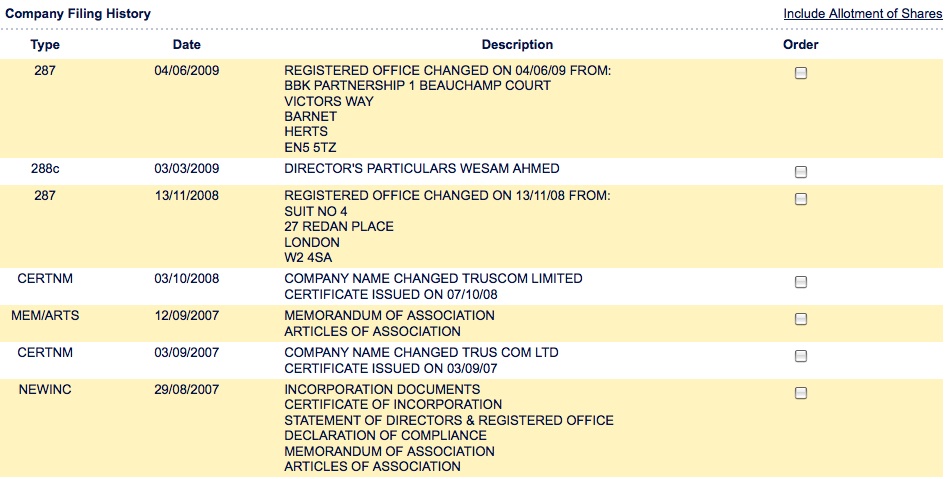 In fact, there appear to be several changes to the record since this company was founded – in August 2007. It first appeared as Trus Com Ltd, then changed to Truscom Ltd before metamorphosing into Forte1 Ltd in October 2008. The company has also changed address twice – from a W2 4SA address in London to an address in Barnet on the outskirts of London.
There are 5 domains hosted on this IP address.
Here are a few of them:
Looking Forward – but don’t ignore what is behind you!
There’s a Russian proverb that goes, ‘He who looks to the past is in danger of losing an eye. But he who ignores the past is in danger of losing two eyes.’
Jeremy Rosen states that he doesn’t know if this is really a Russian proverb – he heard it from Lord Bullock, the historian, biographer of Hitler and Stalin, who was speaking at the Van Leer Institute in Jerusalem many years ago. However the origin is less important in this case than what is being said.
Too often, people make decisions based on insufficient information – they ignore the past, creating excuses saying that the past is a closed book – and base their decisions on the perceived problems of the present, tearing up all that has gone before in an effort to create a desirable future. Others take the opposite view – and dwell in the past, refusing to realize that it is the future that shapes our fortunes, not what has gone before.
In marketing and business the same rules apply. Some are “Risk seekers” – always anticipating a bright future, irrespective of warnings, and ignoring the past. Others are “Risk adverse” scared about what the future may bring – and essentially living in the past. In reality, businesses need to balance both approaches. They need to build for the future, and should grasp emerging opportunities with both hands. However this should be based on knowledge of the risks involved, and this can only come from prior experience and knowledge. Even brand new innovations are built on past knowledge.
There are organizations that seem to focus on past (or should that be passed) glories. They stress how they did this or that – and how they became the market leader through their past actions. However if they fail to see how the present has changed then they will inevitably lose this leadership position. There are numerous companies that have fallen because of this. One of the best examples is J Sainsbury – the UK supermarket giant, currently in the midst of a bidding battle. Sainsburys used to be the largest UK supermarket, but it lost direction, and with it share – it is now no longer the market leader. Sainsbury saw itself as the market leader, but failed to recognize the innovations and different approach of competitors such as Tesco and Asda (owned by Walmart). Essentially, Sainsbury was looking at the past and reveling in it, but in reality was ignoring the past and the lessons it held on success. Sainsbury had grown by being innovative – it was the first UK supermarket, building a major presence by giving customers what they wanted. However by not keeping both eyes open on what was happening in its market, it lost its market position.
A key business skill is being able to anticipate the future (using techniques such as scenario planning). This depends on using drivers and trends from the past to anticipate what could happen in the future. We need to look to the past and learn from it. However our aim should be to build a better future. This cannot come by ignoring what has gone before. Instead we should aim to understand why something happened, so that we can learn from it and not repeat the same mistakes. As George Santayana said in 1905: “Those who cannot remember the past are condemned to repeat it.”
There is a widely known Zen story that shows this in another way:
“When the spiritual teacher and his disciples began their evening meditation, the cat who lived in the monastery made such noise that it distracted them. So the teacher ordered that the cat be tied up during the evening practice. Years later, when the teacher died, the cat continued to be tied up during the meditation session. And when the cat eventually died, another cat was brought to the monastery and tied up. Centuries later, learned descendants of the spiritual teacher wrote scholarly treatises about the religious significance of tying up a cat for meditation practice.”
The importance of lateral thinking!
The supermarket tried various conventional solutions to solve the problem: fences, increased security, and the like. Nothing worked long-term and, moreover, they were all expensive. Then somebody thought that perhaps a different approach might work.
The gangs were all trying to look cool, and the supermarket car-park had gained a reputation as a cool place to hang out at night. So what did the supermarket do? They thought about what could make the car park an uncool place to be, and started up a loud-speaker system piping the music of Mantovani over the parking spaces. Quickly the problem disappeared – as what kind of “cool” 16-18 year old wants to be associated with visiting a location that plays the kind of “easy listening” music beloved by their grandparents!
I teach a weekly diploma course at Thames Valley University, as part of the UK’s Chartered Institute of Marketing‘s Marketing Research & Information module. One of the joys of teaching is that you often learn a lot from your students. Last week was no exception, and provides another great example of lateral thinking – combined with a crucial awareness of the importance of ensuring customer satisfaction while still making money!
One of my students had spent some time working as a hospitality manager in a Greek hotel. He was working the night shift, when a package group of 15 tourists arrived at the hotel. They’d just landed, and the time was 3.00am. All were tired, having had a delayed flight, and all were looking forward to the rooms that they’d paid for. Except because they hadn’t turned up, they had been treated as no-shows, and their rooms had been sold on.
Overbooking is a not-infrequent problem faced by hotels. Normally the way round is to find another equivalent hotel, and transfer the overbooked guests there. Nobody is particularly happy about the arrangement.
- The guests are unhappy as they had been expecting hotel A and got hotel B – and have to move on, when they were looking forward to resting from their journey.
- The hotel is unhappy as the replacement hotel needs to be as good, if not better than the original. This means that the hotel has to pay for its mistake – financially, and if the replacement hotel is not better, in good will and reputation as well, which can be even more important.
Christos found another way.
The locality ran regular cruises to the Greek island of Santorini – which necessitated an early morning start, and a couple of nights on the island.
Santorini is one of those magical islands that, once visited, you never forget. It offers all that is best of the Greek islands – white washed villages, great beaches and views, fun restaurants, archaeological sites, monasteries and churches. However this is not all – it also has a volcano in the middle of the archipelago, with regular trips to see its caldera. This volcano has been attributed to the destruction of the Minoan civilization on the nearby island of Crete, and even the cause of the plagues that the Biblical book of Exodus mentions as having led to the release of the Israelite slaves from their Egyptian servitude (so, for example, the plague of darkness resulted from a cloud of ash that fell from the volcano). This eruption, 3500 years ago, was undoubtedly one of the largest ever volcanic eruptions during human history – much bigger than the infamous 1883 eruption of Krakatoa. The island has even been linked to the legend of Atlantis.
Christos knew that there were always places on this trip. He also knew that the costs of the trip, including the island hotel costs, would be considerably less than what would need to be paid to competitors to find beds for the group so early in the morning, as well as the less tangible costs in lost goodwill and so on. Accommodation on Santorini was much more basic and low cost – but the surroundings compensated for this.
Rather than apologizing to the group, and then getting on the phone to search for replacement hotels at 3.00am – a depressing and tedious task – he welcomed the group and said that they were really lucky. They were the hotel’s 1000th tour group and as such had qualified for a superb prize – a free trip to Santorini to start their holiday with a bang. The tour bus that would be taking them to the boat would be arriving shortly so there was no point in checking them in. They’d check back into the hotel in 2 days time, after their mini-cruise.
The tourist group may have been tired. But tiredness evaporates in such circumstances, and instead of an unhappy and probably angry crowd, you now had customer satisfaction par excellence. Instead of a short-night’s sleep and then a day recuperating by the pool, this group had been chosen to visit one of the highlights of any trip to Greece – for free. The tour group were overjoyed at their lucky break.
Next morning, the day-shift manager queried why the hotel was paying for 15 tourists to go on the Santorini trip. This was normally seen as a profit center by the hotel – as the margins were considerable. Christos explained the situation: how, instead of paying out to competitor hotels to accommodate the overbooked tourists, the hotel had covered its costs by just diverting the payments already made to the tour. Quickly the wisdom of the decision was realized, and it is now part of the hotel operating manual.
More importantly – this second story shows some of the skills all great marketers need:
- Ability to be able to think quickly, laterally and if needed, sidestep conventions and rules;
- Awareness of the importance of customer satisfaction: a happy customer leads to a strong reputation, and repeat purchase;
- Awareness of the importance of profit and that customer satisfaction needs to be balanced by an ability to make money.
Competitive Strategies – the dog fight!
Sometimes selecting the right strategy is not straightforward. You have to think laterally.
People talk about competitive strategy – and how important it is for the business to have an effective competitive strategy. In fact, this is a redundant use of words. If a strategy is not effective, then it is not competitive, and vice versa (i.e. if it is competitive, then it will be effective). So why not just say that businesses need effective strategies.
The following story comes to mind in the context of designing an effective strategy that will beat the competition. (It is also timely, considering the recent London atrocity – still in the news of course). There are five lessons from the story:
- You need to know what you are up against (so do a full SWOT analysis)
- You need to ensure that you have all the facts
- You need to be wary of assumptions – just because you think you know what something is, does not always mean that that is what it is!
- Never underestimate your opponent – they could have a more effective strategy than you have
- Sometimes, to win requires lateral thought. The obvious or standard approach will not win out.
It is now the year 2010. Around 2007, the US and the Al-Quaida network realised that if they continued their fight they would someday end up destroying the world. So they sat down and decided to settle the whole dispute with a dogfight. The negotiators agreed that each would take five years to develop the best fighting dog they could. The dog that won the fight would earn its owner the right to rule the world. The losing side would have to lay down its arms.
Al Quaida found the biggest, meanest Dobermans and Rottweilers in the world. They bred them together and then crossed their offspring with the meanest Siberian wolves. They selected only the biggest, strongest puppy from each litter, killed all the other puppies and fed the lone dog all of the milk. They used steroids and trainers in their quest for the perfect killing machine, until, after the five years were up, they had a dog that needed iron prison bars on his cage. Only the trainers could handle this beast.
When the day of the big fight arrived, the US showed up with a strange animal: It was a nine-foot-long Dachshund. Everyone felt sorry for the US. No one else thought this weird animal stood a chance against the growling beast in the Al Quaida camp. The bookmakers predicted Al Quaida would win in less than a minute. The cages were opened. The Dachshund waddled toward the center of the ring. The Al Quaida dog leapt from his cage and charged the giant wiener-dog. As he got to within an inch of the US dog, the Dachshund opened its jaws and swallowed the Al Quaida beast in one bite. There was nothing left but a small bit of fur from the killer dog’s tail. Al Quaida approached the US, shaking their heads in disbelief. “We do not understand. Our top scientists and breeders worked for five years with the meanest, biggest Dobermans and Rottweilers. They developed a killing machine.” “Really?” the US replied. “We had our top plastic surgeons working for five years to make a Florida alligator look like a Dachshund!”

Go to AWARE's web-site



 Competitive Intelligence News
- AI Marketing Intelligence Tools - trendhunter.com
- Pomo: $4.5 Million Raised For AI Marketing Intelligence Platform - Pulse 2.0
- TapClicks AI Platform Brings New AI Marketing Intelligence Capabilities to Automate Performance Reporting - AiThority
- Pomo Raises $4.5M for AI Marketing Intelligence Platform - National Today
- Five Findings About Today’s Market And Competitive Intelligence Programs - Forrester
- Sales Teams Lose Competitive Deals Without Disciplined Competitive Intelligence, According to Info-Tech Research Group - PR Newswire
- My ‘detective’ job as a competitive-intelligence consultant for pharma - Nature
- Data for growth - Part 4: CRM data enrichment: Sales and marketing intelligence with AI - Moody's
- How a Competitive Intelligence Dashboard Enabled Real-Time Market Monitoring for a Global Enterprise | Astute Analytica - Yahoo Finance
- Market Logic Software Included in Latest Market and Competitive Intelligence Platforms Landscape Report - newswire.com

 Find It Out - Research Secrets and More