Archive
Internet Explorer is for Dummies! Anatomy of a hoax.
Good business intelligence quickly identifies information that is real and what’s false – or should. It’s important that decision making is based on accurate, factual data – as otherwise bad decisions get made. So how do you tell whether something is real or fake?
Generally, the first rule is to check the source or sources.
- Are they reputable and reliable?
- Is the information in the story sensible and reasonable?
- What’s the background to the story – does it fit in with what’s already known?
The problem is that even if information passes these tests it may still not be true. There are numerous examples of news items that sound true but that turn out to be false. One example is a BBC news story from 2002 quoting German researchers who claimed that natural blondes were likely to disappear within 200 years. A similar story appeared in February 2006 in the UK’s Sunday Times. This article quoted a WHO study from 2002. In fact, there was no WHO study that stated this – it was false. The story of blonde extinction has been traced back over 150 years and periodically is reported – always with “scientific” references to imply validity.
The “Internet Explorer users have lower IQs” hoax
Often, the decision to accept a news item depends on whether or not it sounds true. If the story sounds true, especially if supported by apparent research then people think that it probably is – and so checks aren’t made. That is why a recent news story suggesting that users of Internet Explorer have lower IQs than those of other browsers was reported so widely. Internet Explorer is often set up as the default browser on Windows computers, and many users are more familiar with Explorer than other browsers. The suggestion that less technologically adept users (i.e. less intelligent users) would not know how to download or switch to a different browser made sense.
I first read the news story in The Register – an online technical newspaper covering web, computer and scientific news. Apart from The Register, the story appeared on CNN, the BBC, the Huffington Post, Forbes and many other news outlets globally (e.g. the UK’s Daily Telegraph and Daily Mail). Many of these have now either pulled the story completely, just reporting the hoax, or added an addendum to their story showing that it was a hoax. A few admit to being fooled – the Register, for example, explained why they believed it: because it sounded plausible.
The hoax succeeded however, not only because the story itself sounded plausible, but also because a lot of work had been put in to make it look real. The hoaxer had built a complete web-site to accompany the news item – including other research, implying that the research company concerned was bona fide, other product details, FAQs, and even other research reports, etc. The report itself was included as a PDF download.
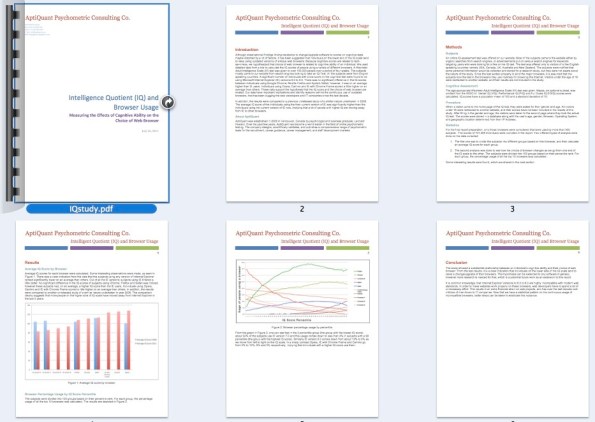
In fact most pages had been copies from a genuine company, Central Test headquartered in Paris and with offices in the US, UK, Germany and India – as was highlighted in an article in CBR Online.
Red Flags that indicated the hoax
To its credit the technology magazine, Wired.com spotted several red flags, suggesting that the story was a hoax, stating that “If a headline sounds too good to be true, think twice.”
Wired commented that the other journalists hadn’t really looked at the data, pointing out that “journalists get press releases from small research companies all the time“. The problem is that it’s one thing getting a press release and another printing it without doing basic journalistic checks and follow-throughs. In this case,
- the “research company” AptiQuant had no history of past studies – other than on its own web-site;
- the company address didn’t exist;
- the average reported IQ for Internet Explorer users (80) was so low as to put them in the bottom 15% of the population (while that for Opera users put them in the top 5%) – scarcely credible considering Internet Explorer’s market share.
After the hoax was exposed, the author, Tarandeep Gill, pointed out several red flags that he felt should have alerted journalists and admitted it had been a hoax i.e.
1. The domain was registered on July 14th 2011.
2. The test that was mentioned in the report, “Wechsler Adult Intelligence Scale (IV) test” is a copyrighted test and cannot be administered online.
3. The phone number listed on the report and the press release is the same listed on the press releases/whois of my other websites. A google search reveals this.
4. The address listed on the report does not exist.
5. All the material on my website was not original.
6. The website is made in WordPress. Come on now!
7. I am sure, my haphazardly put together report had more than one grammatical mistakes.
8. There is a link to our website AtCheap.com in the footer.
The rationale and the aftermath
Gill is a computer programmer based in Vancouver, Canada, working on a a comparison shopping website www.AtCheap.com. Gill became irritated at having to code for earlier versions of Internet Explorer – and especially IE 6.0 which is still used by a small percentage of web users. (As of July 2011, 9% of web-users use Internet Explorer versions 6.0 and 7.0 with a further 26% using version 8.0. Only 7% of web users have upgraded to the latest version of Internet Explorer – v9.0).
The problem with IE versions 6.0-8.0 is that they are not compatible with general web-standards making life difficult for web designers who have to code accordingly, and test sites on multiple versions of the same browser – all differing slightly. (As you can’t have all 4 versions of Internet Explorer IE6.0 – IE9.0 on the same computer this means operating 4 separate computers or having 4 hard-disk partitions – one for each version).
Gill decided to create something that would encourage IE users to upgrade or switch, and felt that a report that used scientific language and that looked authentic would do the trick. He designed the web-site, copying material from Central Test, and then put out the press release – never expecting the story to spread so fast or far. He was sure he’d be found out much more quickly.
The problem was that after one or two reputable news sources published the story everybody else piled in. Later reports assumed that the early ones had verified the news story so nobody did any checks. The Register outlined the position in their mea culpa, highlighting how the story sounded sensible.
Many news outlets are busy flagellating themselves for falling for the hoax. But this seems odd when you consider that these news outlets run stories on equally ridiculous market studies on an almost day basis. What’s more, most Reg readers would argue that we all know Internet Explorer users have lower IQs than everyone else. So where’s the harm?
The facts are that AptiQuant doesn’t exist and its survey was a hoax. But facts and surveys are very different from the truth. “It’s official: IE users are dumb as a bag of hammers,” read our headline. “100,000 test subjects can’t be wrong.” The test subjects weren’t real. But they weren’t necessarily wrong either.
You may disagree. But we have no doubt that someone could easily survey 100,000 real internet users and somehow prove that we’re exactly right. And wrong.
The real issue is that nobody checked as the story seemed credible. Competitive Intelligence analysis cannot afford to be so lax. If nobody else bothers verifying a news story that turns out to be false, you have a chance to gain competitive advantage. In contrast those failing to check the story risk losing out. The same lessons that apply to journalists apply to competitive intelligence and just because a news story looks believable, is published in a reputable source and is supported by several other sources doesn’t make it true. The AptiQuant hoax story shows this.
Meanwhile the story rumbles on with threats of lawsuits against Tarandeep Gill by both Microsoft (for insulting Internet Explorer users) and more likely by Central Test. Neither company is willing to comment although Microsoft would like users to upgrade Internet Explorer to the latest version. In May 2010 Microsoft’s Australian operation even said using IE6 was like drinking nine-year-old milk. If Gill has managed to get some users to upgrade he’ll have helped the company. He should have also helped Central Test – as the relatively unknown company has received massive positive publicity as a result of the hoax. If they do sue, it shows a lack of a sense of humour (or a venal desire for money) – and will leave a sour taste as bad as from drinking that nine-year-old milk.

Go to AWARE's web-site



 Competitive Intelligence News
- Maverick Marketing Intelligence Competition - Spring 2026 - The Shorthorn
- Data for growth - Part 4: CRM data enrichment: Sales and marketing intelligence with AI - Moody's
- Tonic Worldwide launches ‘Groth’ an AI-Powered Marketing Intelligence Platform built to deliver Answers, Not Just Data - MSN
- Lifesight Launches 'Mia,” an Agentic AI Marketing Intelligence Agent - The Manila Times
- Five Findings About Today’s Market And Competitive Intelligence Programs - Forrester
- My ‘detective’ job as a competitive-intelligence consultant for pharma - Nature
- How a Competitive Intelligence Dashboard Enabled Real-Time Market Monitoring for a Global Enterprise | Astute Analytica - Yahoo Finance
- Channel99 Integrates Marketing Intelligence Data with Generative AI Solutions - Demand Gen Report
- Sales Teams Lose Competitive Deals Without Disciplined Competitive Intelligence, According to Info-Tech Research Group - PR Newswire
- AI Ad Generator for Facebook With Real-Time Competitive Intelligence Launched - The Norfolk Daily News

 Find It Out - Research Secrets and More